The short version
- Los Angeles packs more location variety per square mile than anywhere on earth, with urban grit, coastal light, desert edge, and lush hills all within an hour of each other.
- FilmLA's Low Impact Permit Pilot, launched April 27, 2026, cuts the permit cost by 58 percent for small crews shooting three locations or fewer over three consecutive days.
- Music video location rentals on short-term platforms average $96 to $184 per hour in Los Angeles, with warehouse and studio full-day rates running $800 to $3,000.
- The Arts District, Venice Beach, Griffith Park, and Silver Lake each deliver a distinct visual register, and most are accessible with standard FilmLA permits and reasonable planning.
- An LA-native crew that knows the city's light windows, permit geography, and staging logistics saves more time on shoot day than any other single budget decision.
Why Los Angeles Sets the Standard
The light is the obvious answer. Southern California's combination of long golden hours, a coastal marine layer that softens mid-morning shadows, and near-constant sun means a DP can pull frame-worthy images from locations that would look flat anywhere else. But the deeper reason is range. Within an hour of central Los Angeles, a director can shoot downtown brutalism, Malibu sea cliffs, Mojave-edge scrub, eucalyptus hillsides, and Venice Beach murals. No other city gives a production that kind of visual vocabulary in a single shoot day.
Add a century of production infrastructure. Experienced location scouts, permit-savvy local residents, and a dedicated permitting agency in FilmLA that has processed every conceivable scenario. The result is a city that is effectively pre-wired for this work. That infrastructure does not make Los Angeles cheap. It does make it legible, and for a director with a clear visual concept, legibility is worth a great deal.
Urban Industrial: Arts District and Downtown Core
The Arts District is the most-used music video backdrop in Los Angeles for good reason. Exposed brick, roll-up warehouse doors, alley walls covered in gallery-scale murals, and concrete geometry that catches hard afternoon light. The visual density here is exceptional. A camera move that would take an hour to set up in a blank studio happens in a few minutes of walking. It works for hip-hop, R&B, indie, and electronic records equally, because the industrial texture takes color grading extremely well.
Warehouse and industrial spaces in the Arts District list on platforms like Peerspace and Giggster in the $100 to $400 per hour range, with full-day production warehouse rentals running $1,000 to $3,000 for larger column-free spaces with power distribution. For smaller crews shooting exterior alley and mural walls, a FilmLA street permit covers the work.
Downtown's historic core adds a different register. The Bradbury Building atrium, the Broadway corridor in the Historic Core, the First Street bridge, and the Grand Central Market surroundings offer architectural weight and world-city density that reads as ambiguous geography. This is useful when the concept calls for a major-city backdrop without a postcard skyline, a version of Los Angeles that does not immediately announce itself.
Outdoor and Scenic: Griffith, Elysian, and the Hills
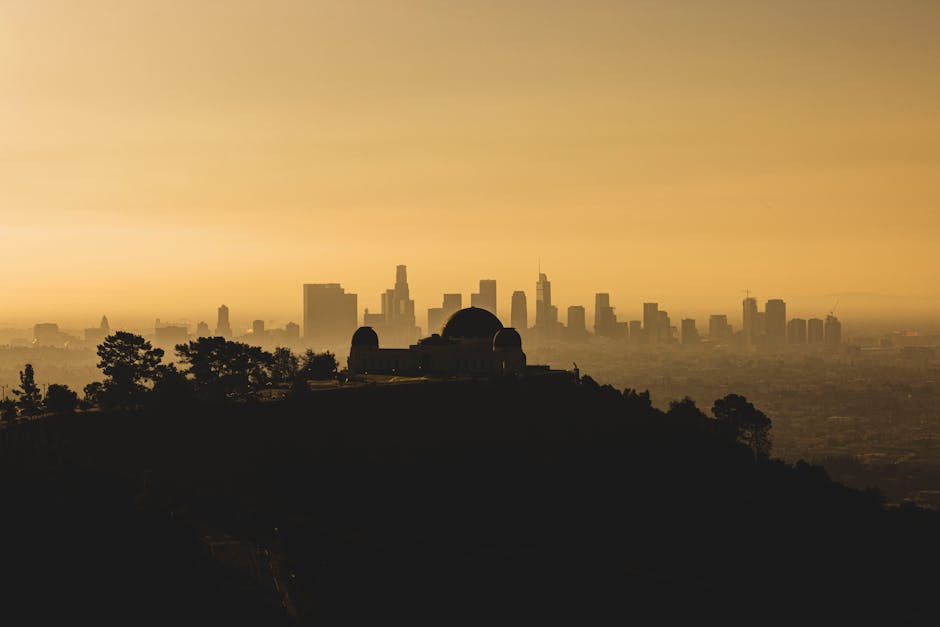
Griffith Park is the city's most recognizable outdoor location. The Observatory on Mount Hollywood delivers the wide city panorama that has become shorthand for Los Angeles itself, the gold-and-grid sprawl reaching toward the Pacific horizon. The lower trails, the old zoo ruins, and the quieter eastern sections of the park offer less familiar options: moss-covered concrete enclosures, overgrown amphitheaters, and eucalyptus corridors with a cinematic atmosphere that does not read as obvious LA at all.
Elysian Park is smaller and significantly less trafficked. It provides secluded hillside trails and city-edge views without the permit competition that Griffith attracts. Both parks require FilmLA permits for any production activity, and crew sizes above certain thresholds trigger LAPD or Park Ranger detail requirements. One important note: hillside and mountain fire zone locations are excluded from FilmLA's Low Impact Permit Pilot, so hilltop shoots fall under standard permit pricing.
The Santa Monica Mountains and the Mulholland corridor open up broader terrain: serpentine roads catching low sun, ridgeline overlooks with the basin stretched below, and the golden-grass hillsides that read as distinctly Southern Californian without a single recognizable landmark in frame. This is the look that anchors more cinematic-register videos, wide establishing shots, vehicle sequences, and the kind of exterior work that carries a full song without feeling static.
Coastal: Venice, Santa Monica, Palos Verdes, and Malibu
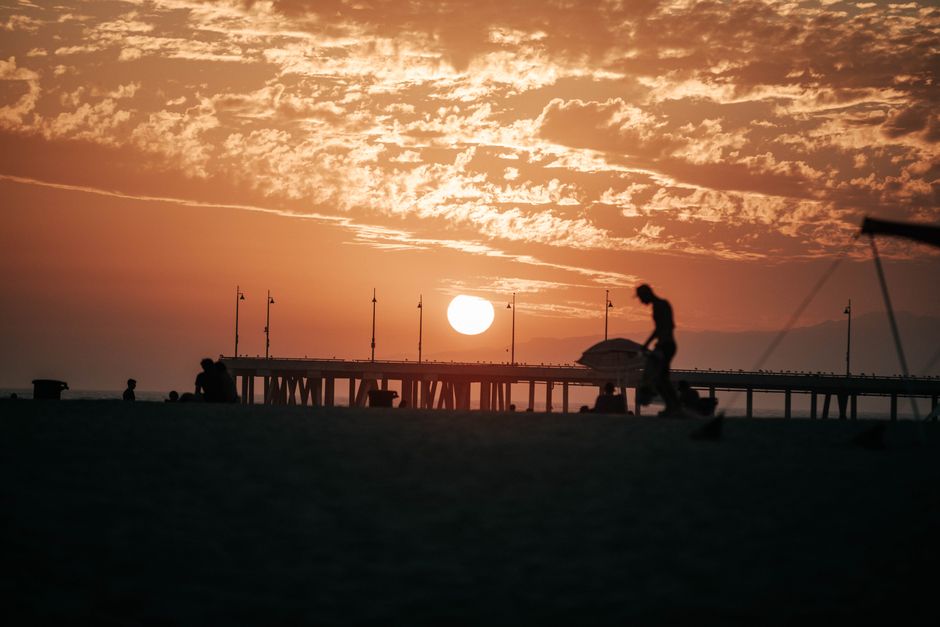
Venice Beach is the most democratic and most used coastal location in Los Angeles. The boardwalk delivers visual complexity that is difficult to manufacture: murals, the muscle beach gym, the pier horizon, and a layered human backdrop that shifts by the hour. Shooting on weekday mornings, before midday crowd density peaks, gets you the visual character of Venice without the logistical friction. The beach zone requires FilmLA city permits, with additional coordination for anything beyond handheld-scale equipment.
Santa Monica Pier adds a warmer, more populist California register. The Ferris wheel, the Pacific horizon, and a color palette of pastels and open sky work well for pop and R&B records where the California visual is part of the story being told.
For something less common and more cinematically scaled, Palos Verdes delivers dramatic coastal cliff geometry overlooking the Pacific with minimal visual noise. The light there runs cooler and more European than the warm basin light near downtown, useful when the concept calls for drama over warmth. Malibu's PCH corridor and Point Dume cliffs offer similar scale with more varied terrain. State beaches and coastal access areas carry their own fee structures administered separately from FilmLA, so confirm those costs before locking a location.
Neighborhood Texture: Silver Lake, Abbot Kinney, and Melrose
The city's creative neighborhoods offer some of the most rewarding and logistically demanding shooting environments in Los Angeles. Melrose Avenue and the Fairfax corridor are mural-dense and constantly changing. A backdrop scouted this week will look different in a month. That ephemerality is part of the appeal: what you capture is genuinely of this moment.
Abbot Kinney Boulevard in Venice delivers a curated version of the LA street aesthetic. Painted storefronts, café terraces, and the low-rise commercial texture of a neighborhood shaped by over a decade of creative occupancy. Silver Lake and Echo Park read younger and rawer, with strong architectural variety in the hillside streets above the reservoir and along Sunset Boulevard. Both register as unmistakably Los Angeles to an audience that knows the city, while reading as a well-art-directed urban street to everyone else.
Shooting in active commercial neighborhoods means coordinating with business owners, maintaining pedestrian flow, and keeping FilmLA notification paperwork current. This is where an LA-native crew pays for itself. They know which blocks cooperate, where to stage production vehicles, and how to move efficiently when an unplanned variable appears. A production that fights the neighborhood loses time. One that knows it moves fast.
What FilmLA Permits Actually Cost in 2026
FilmLA processes all permits for the City and County of Los Angeles. For most music video productions, the current fee structure looks like this:
- Standard permit application fee: $931
- Per-location notification fee: $250 per location
- Low Impact Permit Pilot (launched April 27, 2026): Roughly 58 percent cheaper than standard, available for productions shooting three or fewer locations over three consecutive days with no hillside areas, no city recreational facilities, no driving sequences on public roads, and no buildings taller than four stories
The Low Impact Program is meaningful for independent artists and smaller label productions. A three-location video with a tight crew can be permitted for significantly less than the standard structure, and FilmLA is funding the pilot from its operating reserve. Confirm current availability when building your budget, as the program launched as a six-month pilot.
Beyond FilmLA, costs compound. LAPD or Park Ranger details run $100 to $200 or more per officer per hour where required. Griffith Observatory exterior shoots involve the Department of Recreation and Parks separately. County unincorporated areas, state parks, and beach zones each maintain their own fee structures. Low Impact permits process in a minimum of three full business days. Standard permits and complex multi-location productions require at least five to seven business days. Build that lead time into pre-production before a treatment is approved.

Look-for-Less: Getting the LA Visual on a Tighter Budget
Some of the city's most distinctive video looks are accessible without premium location budgets, provided the scheduling is right. Golden hour at a public park, early-morning residential hill roads, and publicly accessible mural walls require a standard permit and thoughtful timing, not a large location fee. The discipline is in knowing where to look and when to show up.
For controlled environments, studio time is often the most efficient budget line. A modest LA production studio at $800 to $1,200 per day gives lighting control, clean power distribution, and a blank canvas for set building, with none of the weather risk or pedestrian friction that exterior work carries. Short-term rental platforms have LA inventory starting around $50 to $75 per hour for smaller spaces, with warehouse half-day rentals common in the $300 to $500 range with advance booking.
One underused strategy: build concept-driven videos around a single high-quality location rather than spreading budget across four mediocre ones. A $1,500 full-day exclusive warehouse that the team controls completely, lighting, set dressing, access, timing, consistently outperforms a day spent chasing multiple street locations that each require separate setups and permit coordination. Specificity of vision produces better frames than location quantity.
Crew, Coverage, and What to Ask Before You Book
Location knowledge in Los Angeles is a measurable time asset. A DP who regularly shoots the Arts District knows where morning light lands and when freight traffic peaks. A production coordinator who has permitted in Silver Lake knows which council district responds quickly and which does not. For a ten-hour shoot day, these are real schedule differences, not marginal ones.
Full crew day rates for LA music video productions currently range from $5,000 to $15,000 and above, depending on head count and department depth. For single-location or two-location work, a focused crew structure keeps the FilmLA footprint under the Low Impact permit threshold, makes the production more mobile in street environments, and concentrates budget on the frames that matter.
If the project calls for both photo and video deliverables, press stills, behind-the-scenes assets, and social content alongside the finished video, a crew with integrated photo and video capability avoids the call-time and coordination overhead of a second team. One setup, one lighting pass, both formats captured from the same shoot day. For artists building a release campaign around a single production, that kind of multi-format same-day output changes what is possible in Los Angeles on a single budget.
Ready to scout? Book a discovery call and we will put the right LA locations, the right crew, and the right plan behind your record.
One team, full production, out of Los Angeles. Tell us about the project and we will map the right approach on a quick discovery call.
Book a discovery call